

It is often stated that the first feline star of the silent silver screen was Pepper, the Maltese cat who featured prominently in promotions for Mack Sennett studios and starred in numerous shorts and features. While Pepper was undoubtedly the first true cinema cat celebrity, there were cats who made their mark on screen and in the press for other studios. One such cat was Gasoline, who for a while was dubbed the “Vitagraph Cat.”
Now bear in mind, Gasoline was not the only existing “Vitagraph cat” but she was the most prominent of the kitties to grace their New York studio lot, at least as far as the press was concerned. Because so much of Vitagraph’s output has sadly been lost over time we don’t have any actual film of Gasoline in action. (Some sources cite a purr blur in the existing drama An Old Man’s Love Story from 1913 to be the only footage of Gasoline, but the markings of that cat do not match photos of the tuxedo cat which do exist so it is not likely her.)
What we are left with, then, are newspaper and magazine clippings from the era which paint a picture, at least through the publicity department’s eye, of an amiable kitty who was beloved by actors and crew alike. Well, most of them anyway. The first article we could find about Gasoline comes from the December 5, 1915 edition of the Chicago Tribune and makes it clear that one director was not as tolerant of the cat’s intrusion on his set:
Gasoline Upsets a Scene
If there is one prayer that Van Dyke Brooke prays regularly it is: “Deliver me from cats!” If a member of the tribe feline happens to be near, either previous or during the filming of a scene, work stops until the intruder is ejected and Mr. Brooke regains his normal poise.
Gasoline, the Vitagraph cat, to whom he has a special aversion, is aware of this feeling on Mr. Brooke’s part and at every opportunity inflicts her presence on the director. During the taking of the first scene in “Saints and Sinners,” on which Mr. Brooke was working with Maurice Costello as star, Gasoline invited two of her friends to visit the studio. Calmly walking over to where he was busily directing, the three sat watching him.
When the director caught a glimpse of Gasoline and her friends, he grabbed a broom and started for them. Into a scene being taken by Sidney Drew ran the cats, followed by the irate Mr. Brooke, completely disrupting its action. Gasoline, however, eluded the broom at every swipe and, running into the next studio, still followed by her visitors, occupied the center of the stage, where George D. Baker was at work with Edith Storey. Having driven them from the studio where he was at work, Mr. Brooke was satisfied, but not so Mr. Drew and Mr. Baker, whose expostulations heated the atmosphere around Mr. Brooke’s ears until they burned.
With so many actors being mentioned in this article, it’s more than likely a piece of publicity fluff that never actually happened (Van Dyke Brooke at least tolerated having a kitty in the background of the aforementioned An Old Man’s Love Story, which he also starred in and directed.) But Gasoline was becoming somewhat famous and earned her first prominent magazine piece in Film Fun’s July 1916 issue. These provide us with the only known photographs of the cat actor.
She Pussy-Footed Into the Screen
Being the Tale of a Cat
There has been a new and satisfactory policy in regard to character bits allotted to cats. A new and versatile cat is taking all the fat feline parts.
Formerly no one cat seemed to have a frequent place in any of the productions. Inexperienced and transient cats were used. They suffered from nervousness and lack of judgment and insufficient talent. And good extra cats were not always to be had.
Then “Gasoline” arrived. She is a stately cat of the greatest self-possession and histrionic ability. As a type, Gasoline is striking. As a member of the stock, she is indispensable. She has arrived. She is a Personality, Gas is.
She did not romp into the game on a pathway spread with roses and catnip. Hers was the bitter struggle of those who essay to enter a profession already overcrowded. She practically had to pussy-foot her way into the studio where she now enjoys a regal immunity.
Before the rise of Gasoline’s stock, cats had been casual employees, like mob members and elderly extras and babies by the day. But they were never around when you wanted them, and the directors were often in distressful need of a good, resourceful, obedient cat that was not camera-shy. Neighborhood cats were apt to be crude, wild-eyed, untrained creatures that had to be dragged into the sets and tied wth strips of soft cloth to maintain them in indolent domesticity.
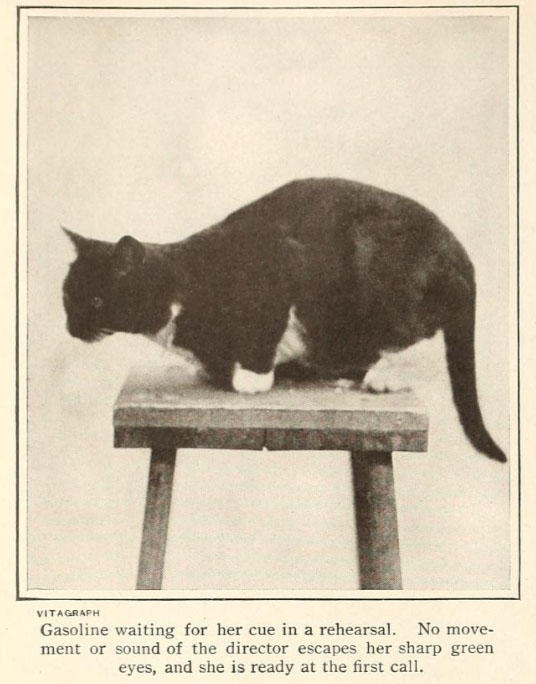
Then Gasoline cut in. She haunted the outskirts of the studio at first, wandering in occasionally with an absent-minded air that sought to frustrate suspicion. Large and impatient feet hoisted her out again. She kept oozing back into the premises right along, arching herself along with a deprecatory manner that gradually won her friends at court. She had several good points. She kept punctual hours, being right on hand with the rest of the employees; and she had very ladylike habits.
At last came her great opportunity. Her inspiration led her to be found asleep on the surface of a lemon meringue pie. The scene was taken before she was observed, and there ensued wild clamor for her life. It meant a retake.
“Not on your life!” whooped the director, who knew a good thing when he saw it. “It’s the making of this scene!”
Her stage presence, her grace and aplomb have never deserted Gasoline from that moment. She has been called upon to play difficult cat parts in many plays and invariably receives with serenity the avowed admiration of everybody.
Gasoline is passionately fond of her art. She has resolved to devote all her lives to it. She is so enthusiastic, in fact, that she needs to be watched, lest she walk into scenes that were better catless. Once the camera begins grinding and the blue lights flicker, Gasoline is right on the job, purring and twitching tail tip.
That’s all about Gasoline, except how she got her name. She received it with her art and advent into stardom. For sometimes she gets a trifle dusty and shopworn, and it has been the practice to dry-clean her. For this reason she generally enters a scene with a faint odor of gasoline about her — perfectly clean, but a trifle insistent. And hence the name.
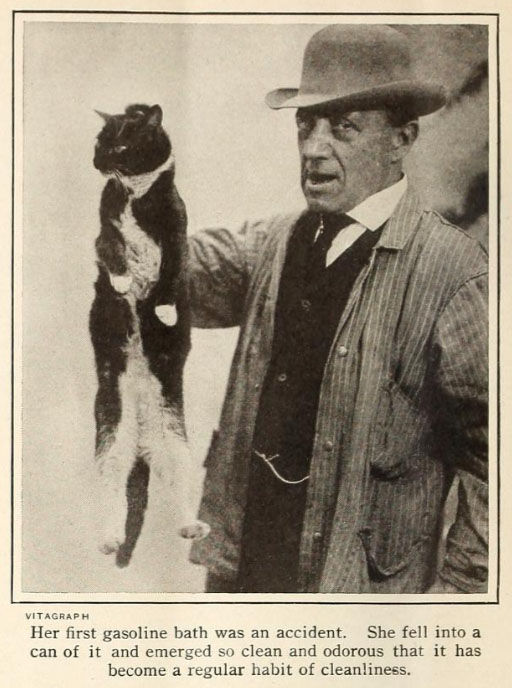
One of Vitagraph’s most popular stars during that time period was Bobby Connelly who started his career on film at age four. In 1914, at age five or six, he signed with Vitagraph to star in a series in which he was known as Sonny Jim. The Sonny Jim films proved to be quite popular and the studio’s press department built up the relationship between Bobby and his kitty co-star. One lengthy article purportedly written by (or at least transcribed from) Bobby himself included several mentions of Gasoline (referring to the cat as a he, not a she), but in a rather shocking way that would eerily predict similar claims from child star Jackie Cooper in coming years:
Little Movie Actor Tells His Story: Bobby Connelly, 6-Year-Old Star, Writes to Junior Eagle Readers About His Work
“Dear Junior Eagle Readers — I know that you all like moving pictures, and many of you may have seen me act. It is lots of fun most of the time, but I often get very tired and wish I was like you — going to school and playing all afternoon. Of course, I go to school, but I do not get much chance to play except with Gasoline. Gasoline is a big black and white cat at the studio, and he is very gently. Whenever I go over to Elm Avenue with my mother to get my lunch, I always save a piece of meat for Gasoline, and he is always waiting for me, purring and rubbing his furry head against my legs.
I was in a film the other day, where I was expected to cry. I did not feel much like crying, but they told me I had to. I had a piece of candy in my pocket, and if they had taken that away from me I would have cried all right. How do you think they made me cry? They told me that Gasoline, my nice cat, had been run over. I began to cry, and then they turned on the lights and the camera man took my picture. After that they told me Gasoline was all right and, my, but I was glad. I patted him and held him in my arms.
It is awfully funny to see yourself. A part of film was shown when one of the women down here was supposed to be my mother. She wasn’t at all, for my mother is different and is here with me all the time I am acting, only she never gets her picture taken. Well, the woman they said was my mother was dying in bed. It was terribly sad. I cried a little when I saw it. But right then I saw myself in another room and I was crying hard. When you see the picture you will think I am crying because my mother is so sick. I’m not, though. I’m crying because they said that Gasoline was dead. I did not know anything about this woman they said was my mother.”
— The Brooklyn Daily Eagle Sun, February 13, 1916

The tuxedo cat actress must have caught the public’s fancy in some capacity, because blurbs about the Vitagraph cat continued for the next few years. She was often mentioned alongside other human and animal stars in print, including the studio’s rodents (both domestic and wild) who were either her preferred meal or her adopted children, depending on which story you believe.
Vitagraph’s pet cat, “Gasoline,” has had the different players worried lately. It seems that she had chased all the mice away from the studios and refuses to eat anything that can be bought for her. Offerings of catnip, liver, fish and all other feline delicacies have been indignantly refused by the pet of the studios. — Springfield Leader and Press, May 21, 1916
Some people believe in choloroform, but the two pet white rats at the Vitagraph have been Gasolined. Having lost all her kittens, the studio cat, Gasoline, just had to adopt something. — Motion Picture Supplement, November 1915
Poor Gasoline ended up with a rival for Bobby’s affections, as reported in the Iowa City Press on June 30, 1916:
Bobby Connelly, of the Vitagraph Company, has just received a present of a beautiful poodle. Some friend sent the dog to Bobby from the far west by express and during the last few days the pair have become inseperable. Although the studio cat “Gasoline,” and the little white mice who live in the large Vitagraph garage still receive a kind word now and then, Bobby staunchly declares that he only likes them “most as much as Censor,” which he has named the poodle.
Gasoline could also be pulled up to provide a punch line in stories promoting other stars, although if this one were to be believed it doesn’t say much for actor James W. Morrison:
The secret is out why Jimmie Morrison, the Vitagraph lead, is in disgrace. Some time ago he escorted a very respectable female to a tavern and persuaded her to taste raw liquor for the first time. After that he deserted her, and she staggered back to the Vitagraph yard alone. Gasoline, the Vitagraph cat, has never been quite the same grimalkin since. “Gasoline” was Jimmie’s victim. — Norfolk Daily News, August 28, 1916
Columnist Anita Stewart offered some “inside” information about the Vitagraph studio animals, including Bob, a lame dog, Gasoline, and the Vitagraph mice and sparrows, in her column, Anita Stewart Says, published in The Wilmington Dispatch on December 1, 1926 (note her story about how the cat got her name differs from the previous tale):
Animal Friends at the Studio
All kiddies love animals, so this talk is specially for all the little friends I have. It is about the pets of the big Vitagraph studios in Brooklyn. There are a number of animals that bask in the love of the different players and that take part, now and then, in the movies themselves.
. . . “Gasoline,” the black and white cat, spends her days in one of the big glass studios. Perhaps you think that a very funny name for a cat. I did too until I learned how it came about. You see, when “Gasoline” was a little roly-poly kitten she was always to be found in the garage. Naturally she was almost always covered with motor grease and gasoline. That’s why they have her such an odd name. And let me tell you something funny. “Gasoline” played a trick upon her friends. For, the minute they christened her, she deserted the garage and has not been found there since. Just at present “Gasoline” is so busy caring for her large and new family of baby “Gasolines,” that she has not wandered often across the front of a “set” while they were taking a scene.
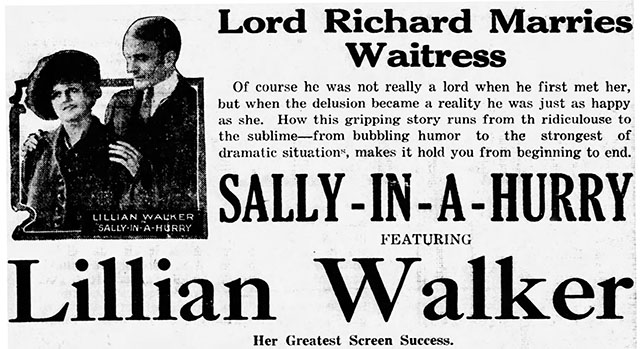
We have to assume that Gasoline had star quality on the screen as well as in person if we take into account the praise she received for her role in the comedy / drama Sally-in-a-Hurry also starring a canine thespian Tige and Vitagraph player Lillian Walker. The film’s story was described as such: “How a pretty waitress in an ordinary lunch room, after cherishing a newspaper picture of Lord Richard, finally met and learned to love whom she termed her “fairy prince,” furnishes many laughs as well as a most intense dramatic situation.” But apparently Tige and Gasoline ran away with some of the scenes.
Feline and Canine Stars at the Garing Tuesday
Unusual Human Interest Contained in Many Scenes.
One finds it difficult to understand how Wilfrid North, who directed the Vitagraph Blue Ribbon Feature, “Sally-in-a-Hurry,” starring dimpled Lillian Walker, which is at the Garing theater on Tuesday, was able to get such a clever performance from the two animals seen in the film.
Both “Gasoline” the black and white cat who basks in the affections of all the players at the Vitagraph studios, and “Tige” the dog who is also a prime favorite, play important roles. In reality they are the best of friends and may be seen sleeping side by side in one of the studios at any time. In this production, however, they seem to be anything but friendly.
A close-up view of the sofa is shown covered with pillows when all of a sudden one of the pillows moves and who stalks forth but “Gasoline.” For a time she plays about with a ball of twine but at “Tige’s” entrance to the room her tail grows immense and her hair stands erect while she hisses at him threateningly.
One would believe that he would spring for her throat if he wasn’t held so securely by his master, for he bounds forward as though trying to break the leash which holds him and barks and growls angrily.
Finally the man drops the leash and with a leap the dog springs for the sofa while “Gasoline” thrusts out a paw as though to scratch his eyes out if he comes a step closer.
There is no doubt about their intentions toward one another in the picture but the moment the director called “Righto” and the camera-man stopped grinding their friendship seemed restored and they walked out of the set side by side.
Even Miss Walker marvels over her director’s skill for although both “Gasoline” and “Tige” are movie animals their acting in these scenes is worthy of the greatest praise. — The Greenville News, April 29, 1917
Gasoline appeared to finally be reaching star status but it isn’t clear if she suffered from that dreaded plague that seemed to befall and ruin the career of many a hopeful starlet: temperament. By all accounts Gasoline was a mellow, cordial cat who caused no difficulties (except maybe to the aforementioned director Van Dyke Brooke) but the last reported article we could find made it sound as if maybe she was growing a bit jealous of her co-stars. The incident reportedly occured during production of The Message of the Mouse, a Greater Vitagraph Blue Ribbon feature starring Anita Stewart and directed by Commodore J. Stuart Blackton. A search for a talented mouse produced the star of the film, and once the picture was finished the mouse continued to live in the studio in a cage where Miss Stewart fed him chocolates regularly, until . . .
One day, his Mouseship got out of the cage and “Gasoline,” the Vitagraph studio cat, saw him. That was the end of his career as an actor. “Gasoline” made him go so fast the mouse was named “Jitney.” But he never knew it, because he never went back to the studio. — Evening Capital and Maryland Gazette, September 25, 1917
We don’t know whatever became of Gasoline, but her name and talents did not seem to be passed down to any of her children and like many a Hollywood talent her star eventually just fizzled out. Sadly, her career was not the only one to end too soon. In 1917, Bobby Connelly was diagnosed with endocarditis but continued to work in films, keeping the same grueling schedule. It finally caught up with him when the boy became seriously ill after completing production on Wildness of Youth and passed away from bronchitis on July 5, 1922, at the tender age of 13. One would like to think he and Gasoline were reunited in a happier place where Bobby could finally just play with his kitty friend like other kids.